卡爾加里金標誌

加拿大卡加利黃金部落格

首頁 " 加拿大黃金 – 卡加利部落格 " What Precious Metals Might Be Hiding on the Moon?

What Precious Metals Might Be Hiding on the Moon?

4 月 10, 2026

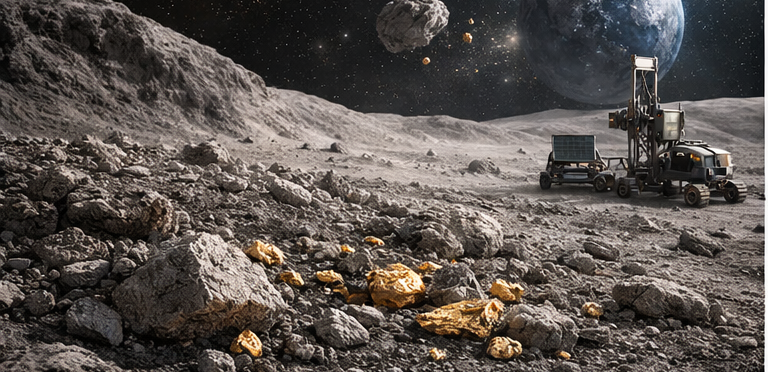
As humanity prepares to return to the Moon through missions like Artemis II, there’s renewed excitement about what awaits us beyond Earth. While the mission itself is focused on sending astronauts around the Moon and laying the groundwork for future exploration, it also sparks a bigger question: what resources – and secrets – are waiting on the lunar surface? Among them, the idea of precious metals like gold captures both scientific curiosity and the imagination.

At first glance, the Moon appears geologically quiet and resource-poor – but its surface tells a more complex story. Scientific analysis of lunar samples returned during the Apollo missions confirms that the Moon does contain trace amounts of precious metals, including gold and platinum group elements.

These materials are present primarily due to:

  • Meteorite bombardment: For billions of years, the Moon has been exposed to asteroid impacts, which delivered small quantities of metal-rich material.
  • Shared origin with Earth: The prevailing theory is that the Moon formed after a Mars-sized body collided with early Earth. As a result, both bodies share similar elemental compositions, including trace heavy metals.


However, there’s an important limitation. Unlike Earth, the Moon lacks active geology – there are no plate tectonics, no circulating water, and minimal volcanic redistribution today. On Earth, these processes concentrate metals into economically viable deposits. On the Moon, metals remain diffuse and sparsely distributed, making large-scale extraction impractical with current technology.


How Gold Is Forged in the Universe


Gold’s origin lies far beyond any planet – it is the product of some of the most extreme events in the universe.

Elements lighter than iron are formed through fusion inside stars. But gold, being much heavier, requires a different process known as the rapid neutron-capture process, or r-process.

The strongest evidence today points to:

  • Neutron star mergers (kilonovae) as the primary source. When neutron stars collide, they produce and eject large quantities of heavy elements, including gold.
  • Certain rare supernovae as a secondary contributor, though they are now thought to play a smaller role than neutron star mergers.

In these events, atomic nuclei are bombarded with neutrons at such a rapid rate that they build up into heavy, stable elements – including gold.

Put simply: gold is formed in cosmic collisions and explosions, not in ordinary stars.


How Gold Became Part of Our Solar System


After being forged in distant cosmic events, gold atoms drifted through interstellar space for millions – or even billions – of years. Eventually, they became part of the vast cloud of gas and dust that collapsed to form our solar system around 4.6 billion years ago.

During this process:

  • Dense elements like gold were drawn inward as planets formed
  • Much of Earth’s early gold likely sank into its core during its molten phase

This leads to a fascinating conclusion: most of the gold accessible in Earth’s crust today likely arrived later, delivered by meteorites during a period known as the Late Heavy Bombardment (approximately 4.1 to 3.8 billion years ago).

The Moon, lacking Earth’s gravity and geological recycling, also accumulated impact-delivered metals – but without the processes needed to concentrate them.


Other Fascinating Gold Facts


  • Gold is older than the Earth
    The atoms themselves were formed long before our planet existed.
  • Much of Earth’s accessible gold is extraterrestrial in origin
    It was likely delivered after the planet’s core had already formed.
  • Gold is chemically resilient
    It resists corrosion and oxidation, allowing it to persist over geological timescales.
  • Asteroids may hold more accessible gold than the Moon
    Some are believed to contain significantly higher concentrations of precious metals.

As missions like Artemis II bring us closer to the Moon than we’ve been in decades, they also bring perspective. The gold we value so highly on Earth is not just a resource – it’s a fragment of cosmic history.

最近的部落格文章

如何測試金飾:瞭解硝酸觸石法

如何測試金飾:瞭解硝酸觸石法

當顧客把珠寶帶到加拿大黃金中心時,我們最常聽到的一個問題是:“你怎麼知道這是不是真黃金?專業的貴金屬買家會依賴幾種不同的測試方法來安全、準確地評估珠寶....

瞭解收藏幣與金銀幣的差異

瞭解收藏幣與金銀幣的差異

在加拿大黃金公司,我們經常收到的一個問題是:收藏幣和金銀幣之間有什麼區別?雖然兩者都是由黃金和白銀等貴金屬製成,但它們的價值卻截然不同,尤其是在出售....。.

黃金:閃爍多彩!

黃金:閃爍多彩!

提到黃金,大多數人都會聯想到傳統的黃色光芒。儘管如此,時尚與珠寶趨勢的演進已為這種貴金屬開啟了市場,讓其可因應獨特的成分、特性與美感而量身打造......